
Following Cheyenne County Recent Arrests
The official Cheyenne County Sheriff's Office website shares agency news, contacts, and photos. It posts no searchable booking table. Its Detentions page points toward Prowers County. That hint only goes so far. A 2021 sheriff report placed arrestees in Bent, Kit Carson, and Prowers county jails. A February 2026 news account described transport to Kit Carson County Jail. The receiving facility clearly changes case by case. So none of these clues settles where a given person sits right now.
| Window | Verified source | Best route |
|---|---|---|
| Same day | No official 24-hour feed located | Use 24 Hour Arrests, then ask the sheriff for the receiving jail. |
| Several days | No rolling blotter located | Use the Arrest Log for agency news, dated reports, and court follow-up. |
| Current custody | No Cheyenne online roster located | Confirm the destination and use that jail’s official process. |
| Later activity | Official court docket | Search hearings, then request the disposition. |
The captured official sheriff site shows the agency surface available to the public.
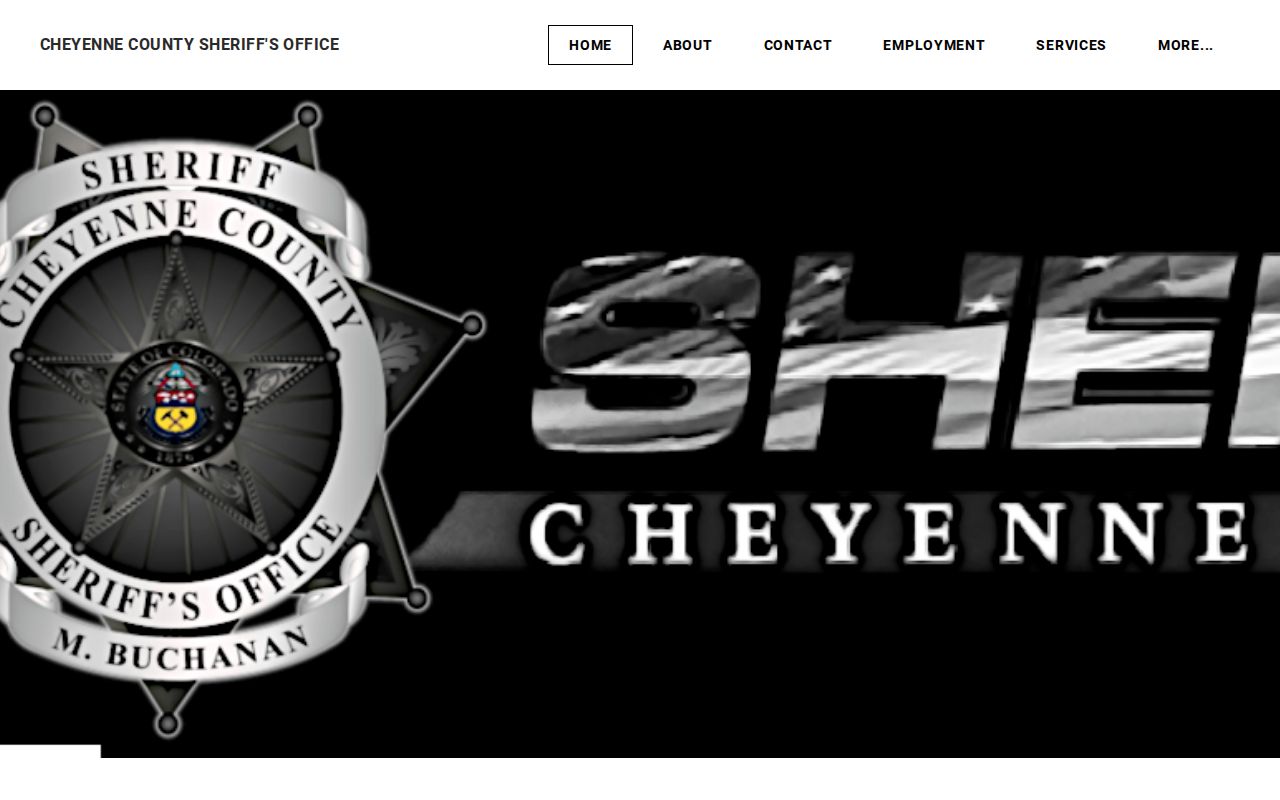
Treat it as a starting point, not a roster or custody result.
Arrested Last Night in Cheyenne County
For an overnight arrest, call the Sheriff's Office at (719) 767-5634. Dispatch answers at (719) 767-5633. Ask staff to confirm the receiving jail, the booking date, and the booking number. Prowers looks like the natural lead. Yet Bent and Kit Carson both appear in documented cases. So no single answer fits every arrest.
Booking can trail the arrest itself. Transport takes time. Cheyenne County publishes no set posting hours. It offers no refresh schedule and no photo or archive rules. For custody alerts tied to one person, the VINELink Check walks through participating-jail searches. It also explains notifications. Skip dated news clips and unofficial directories when you need current confirmation.
Cheyenne County Arrest Roster Routes
Cheyenne County posts no public jail roster. That means no verified search fields, photo rules, update cadence, or archive depth to describe. One caution: an online roster under this county's name belongs to Cheyenne County, Nebraska. It has nothing to do with Colorado arrests.
| Search detail | Why it matters |
|---|---|
| Legal name and date of birth | Reduces name-only mismatches where lawfully available. |
| Arrest and booking time | Separates initial custody from later intake. |
| Arresting agency | Identifies the likely incident-report custodian. |
| Receiving jail | Identifies the likely intake, bond, release, and photo custodian. |
| Booking or case number | Provides a more exact key than name alone. |
- Call the sheriff and ask which facility accepted the person.
- Check that facility’s official custody channel.
- Ask whether intake is pending, or the person is held, released, or transferred.
- Use the court docket for hearing activity, not custody proof.
- Request intake records from their actual custodian.
The official sheriff contact page supplies the fallback information.

This route can help identify a receiving jail, subject to law and agency policy.
Where Cheyenne County Arrests Are Published
| Channel | Photos? | Status | Use |
|---|---|---|---|
| Sheriff site | No booking feed verified | Official | Check news and contacts. |
| Receiving jail | Policy varies | Official when agency-run | Use after confirming the destination. |
| Court docket | No | Official | Find hearings, not custody. |
| Kiowa County Press and Kiowa County Independent | Editorial images may appear | News | Dated context, not a complete roster. |
| Jailexchange | May discuss photos | Unofficial | Discovery only; assumptions conflict with variable housing. |
| Major aggregators | Varies | Unofficial | No verified local Cheyenne section was found. |
The sheriff runs no booking app and no social booking feed. The Photos link on the county site is not a mugshot feed. Emergency alerts are not arrest alerts. One Kiowa County Press item carried a bi-weekly label and a dated housing list. But that proves no ongoing schedule. Trust official sources first.
Recent Arrests by City
Just two incorporated towns sit inside Cheyenne County. The county's own page separates Cheyenne Wells and Kit Carson from unincorporated Arapahoe and Wild Horse. No municipal police roster or city booking feed exists for any of them.
- Cheyenne Wells Recent Arrests: the county seat relies on the sheriff as the identified starting point, followed by the receiving jail.
- Kit Carson Recent Arrests: the town also routes through the sheriff. Kit Carson the town differs from neighboring Kit Carson County and its jail.
The official county sheriff page provides agency context for both places.
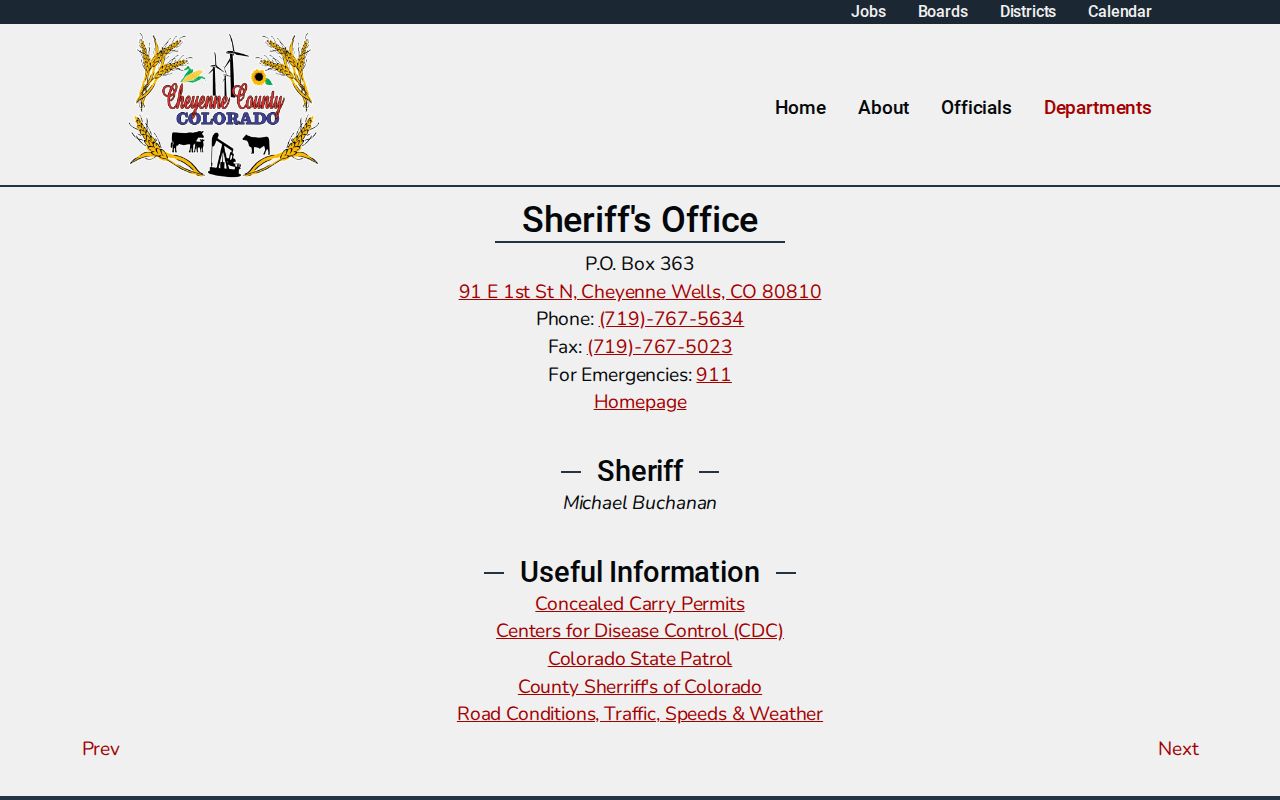
The county page identifies the sheriff resource, not a municipal arrest list.
What a Cheyenne County Arrest Record Shows
| Field | Meaning |
|---|---|
| Name and booking number | Identity and event keys; name alone is not confirmation. |
| Arrest and booking times | Separate moments because transport precedes intake. |
| Agency and location | Who arrested the person and where; the jail can differ. |
| Charges as booked | Preliminary charges, not final guilt. |
| Bond | Amount or type that may change after court. |
| Facility and release | Location or status at the time checked. |
| Photo and descriptors | Intake material if created and disclosed. |
| Case and court date | Links booking to later proceedings. |
| Disposition | A court outcome, never a booking field. |
The arresting agency keeps incident and probable-cause material. The receiving jail holds intake, custody, bond, and release details, often with the booking photo. Courts keep the docket and final outcome. Juvenile, sealed, and safety-sensitive records may stay off limits.
Cheyenne County Arrest Photos and Mugshots
Cheyenne County publishes no rule guaranteeing that every adult booking photo appears online. It also sets no fixed removal date after release. A receiving jail may take the portrait at intake and keep it. Access then depends on that jail's policy, Colorado law, sealing, and any court order. For someone later moved into state custody, the Colorado Department of Corrections locator helps, though photo availability varies by profile. That locator tracks prisons, not fresh Cheyenne County arrests.
So work from the receiving jail. Ask for the arrest record and the photo as separate requests. Useful questions: who created the photo, what disclosure rule applies, and whether a sealing, expungement, juvenile restriction, or court order covers it. Photos may also have been transferred or destroyed over time.
Skip the aggregator sites. Busted Newspaper, RecentlyBooked, Mugshots.com, Arrests.org, and Mugshots.zone list no Cheyenne section, and Jailexchange cannot confirm custody. Their pages go stale fast. Never pay a middleman who promises mugshot removal. Fix the official record or court file first, then use a publisher's own free correction channel.
How to Obtain a Cheyenne County Arrest Record
- Gather the name, date range, agency, jail, booking number, and case number.
- Call (719) 767-5634 and ask for the current records custodian. No booking-specific form or records line was published.
- Ask the arresting agency for its report and the receiving jail for intake, custody, release, and photo records.
- Request court disposition documents from the Judicial Branch.
- Ask for fees, redactions, denial authority, format, retention series, and timing.
The Clerk & Recorder's CORA form offers useful local guidance. It may not govern the sheriff. The form allows three working days for inspection, with a possible seven-day extension after notice. Fees run 25 cents per page or emailed page. A CD costs $1, and a flash drive costs $10. Personnel time beyond two hours is billed too. Another custodian may set different terms. For court documents and dispositions, the official court request page is the right stop.
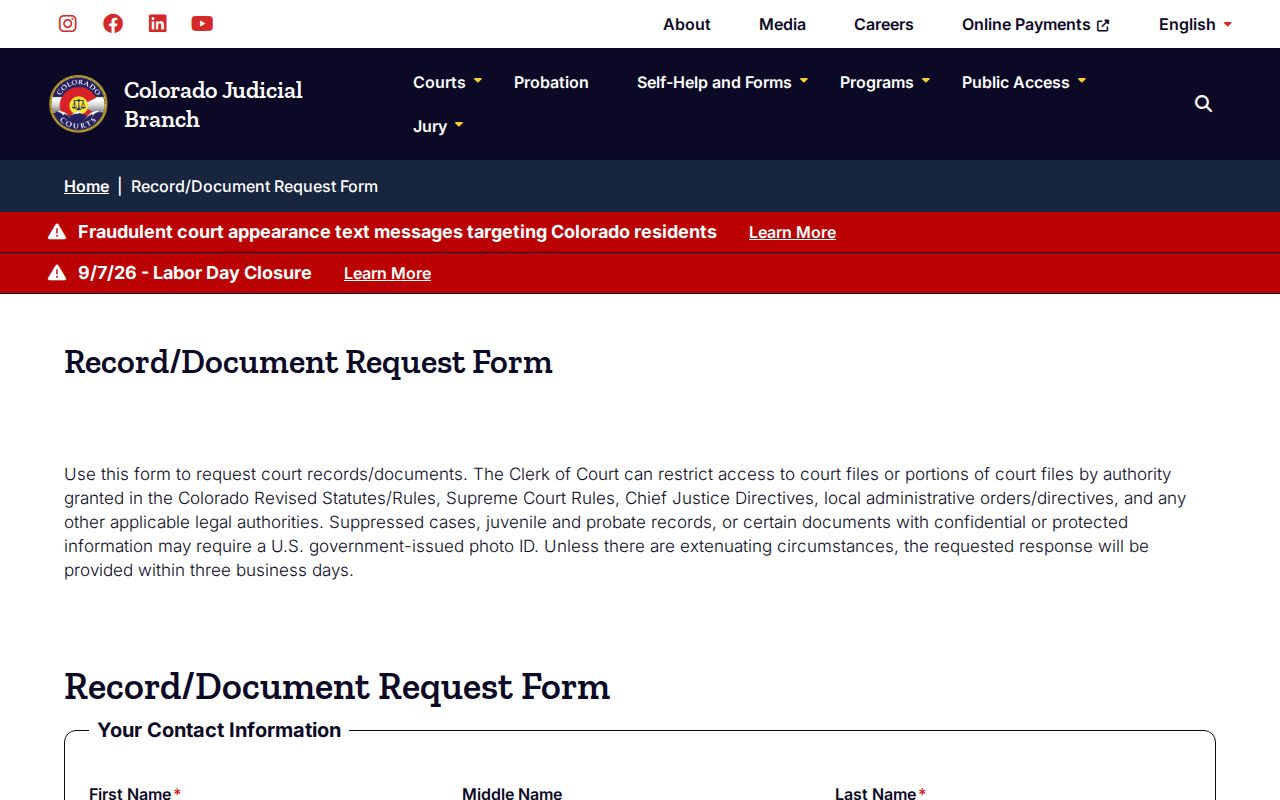
It does not replace a sheriff or receiving-jail request.
Arrest Records, Removal, and Colorado Law
Colorado's public and criminal-justice record rules live in Title 24, Article 72. Access has limits. Juvenile status and privacy restrict what gets released. So do active investigations and victims. Security concerns, sealed records, and court orders also limit the release. Colorado Revised Statutes §24-72-305.5 targets booking photos used for paid publication and fee-for-removal schemes. A payment demand is a red flag, not a remedy.
Colorado's Judicial Branch offers more than one sealing route. No-charge arrests, non-convictions, convictions, municipal cases, and juvenile matters each follow separate paths with their own eligibility rules. Removing a page does not change the official record. Busted Newspaper, RecentlyBooked, and Mugshots.com publish site-wide free correction routes. No local coverage or outcome can be promised.
Cheyenne County sets no fixed retention period for booking photos, intake sheets, or logs. A statewide schedule gives examples. Misdemeanor cases run three years, daily activity reports two, and field contacts three. Those numbers are not a local photo guarantee. Ask which series applies and whether Cheyenne adopted it. A receiving jail or an outside vendor may control the item instead.
For older files, ask the custodian whether the records remain, were destroyed, or were transferred. The Colorado State Archives database is incomplete. Its Cheyenne finding aids list no booking-photo series. Historical archive material cannot prove current custody.
Arrest Warrants and Most-Wanted Information
Cheyenne County publishes no active-warrant portal or most-wanted list. For the official process, contact the sheriff or the Cheyenne County Combined Court at 719-767-5649. A docket entry alone does not prove a warrant is still active. Never approach a wanted person. Call 911 for emergencies. Otherwise, use official channels, and anyone personally concerned about a warrant should contact counsel or the court directly.
After an Arrest: Court Dates and Dispositions
Cheyenne County sits in Colorado's 15th Judicial District. A docket may list the hearing type, location, appearance, and courtroom, but it is not a custody roster or the final record. Online access stays limited. A commercial register of actions is not the official court record. Request the disposition when accuracy matters. The official Cheyenne docket shows the court channel at work.
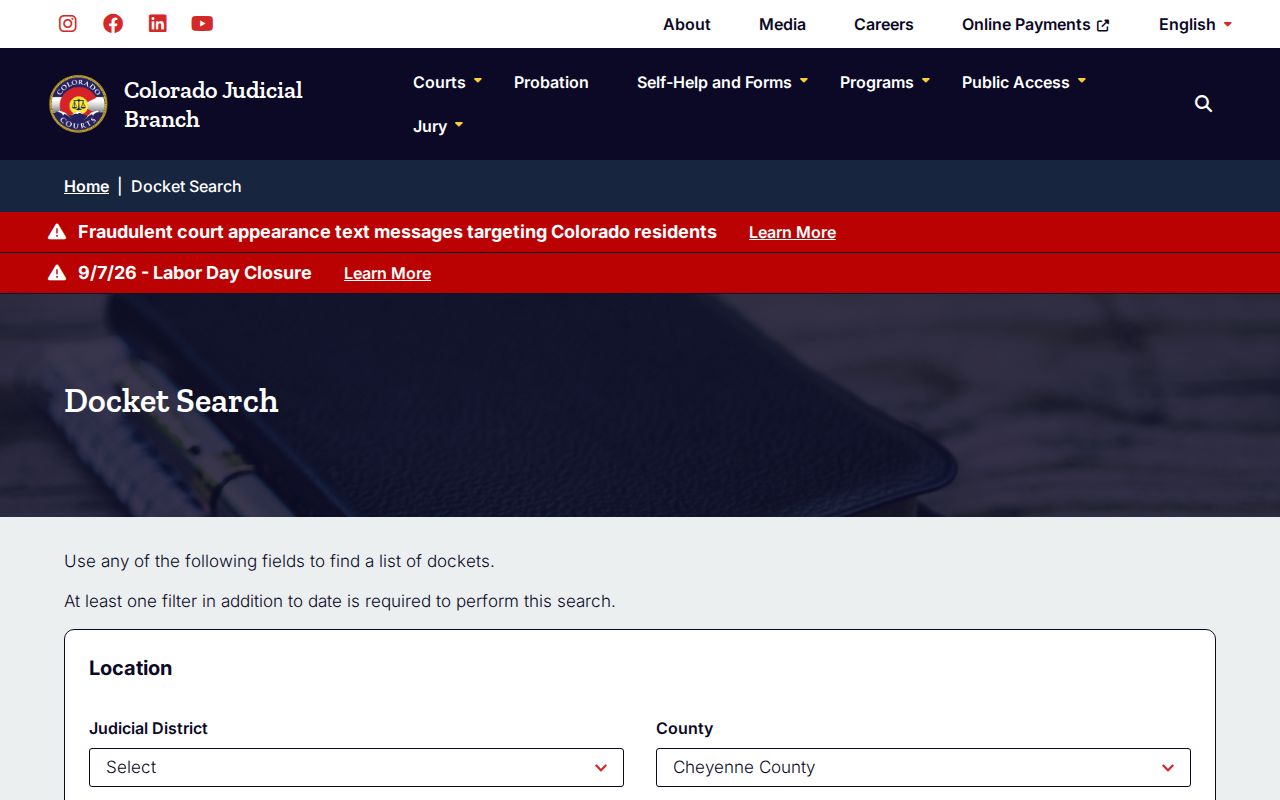
A match locates a hearing, not current custody or the final outcome.
State Prison and Federal Custody
The Colorado Department of Corrections locator covers people sentenced to or recorded in state corrections. It misses many recent arrests. Someone bonded out or held locally before trial will not appear there. Search by legal name and DOC number, then compare facility and status. Photos vary by current profile. The older endpoint may fail, and ORILE remains a law-enforcement portal rather than a public roster.
The Federal Bureau of Prisons locator covers federal custody and has no booking-photo field. ICE's locator requires exact information and promises no photo. U.S. Marshals policy limits public prisoner photographs. Each system tracks a distinct custody state, so an empty result does not mean release. See the photo section for lawful requests.
Reading Arrest and Custody Results Carefully
Why can an arrest show up in news but not in a jail search? News captures one event at a stated time. A jail search captures a single facility's custody population at the moment you check it. Between those moments, a person can be transported, processed, released on bond, moved to another jail, or excluded from public display. Cheyenne County's receiving jails vary. That makes the gap matter more. Record the publication date, incident date, agency, and stated facility, then confirm any later custody claim with the official custodian.
Does a court entry prove someone is still jailed? No. A docket shows case or hearing activity only. Bond can change, a hearing can be continued, and a defendant can appear after release. A missing online result has many causes too. Limited access, spelling differences, delayed filing, juvenile restrictions, sealing, or suppression can all hide an entry. Match identifiers carefully and ask the court for an official disposition rather than trusting one entry.
Keep a lookup log. Note the date and time each source was checked, the exact county and facility, the identifiers used, and the office contacted. That habit keeps a stale screenshot or a similarly named county from turning into a false live answer. It also sharpens a records request. Do not publish sensitive identifiers just because they helped confirm a lawful search.
Official Arrest Sources and Their Boundaries
No single master record exists. The sheriff, receiving jail, court, CDOC, BOP, and ICE each describe a different stage and own different documents. The sheriff can address the arrest and its destination. A receiving jail handles booking and current local custody. The court documents prosecution and disposition. CDOC covers state corrections, while federal and immigration systems cover their own custody. A careful lookup follows those stages instead of treating one database as complete.
Local newspapers add context when they name a date, place, agency, or transport destination. The Kiowa County Press bi-weekly report is useful evidence that housing once crossed county lines. Its old list must never pass as current. Each story documents only the event it describes. Editorial photographs are not automatically booking photos, and neither publication promises that every arrest appears.
Missing aggregator coverage matters too. A statewide page, a guessed URL, or a similarly named county in another state is not a local source. If an unofficial Cheyenne page appears later, compare it with the originating agency and court. Note the access date. Avoid repeating unsupported custody claims. Third-party data is never an official custody or court result.
Use neutral language when you ask an agency to confirm a status. Ask what the status field means. Do not ask staff to speculate about guilt or future charges. If sources disagree, keep both access dates. Ask the custodians to reconcile them. Report a later court disposition alongside the historical arrest rather than silently replacing it.